
MOX Fuel Fabrication
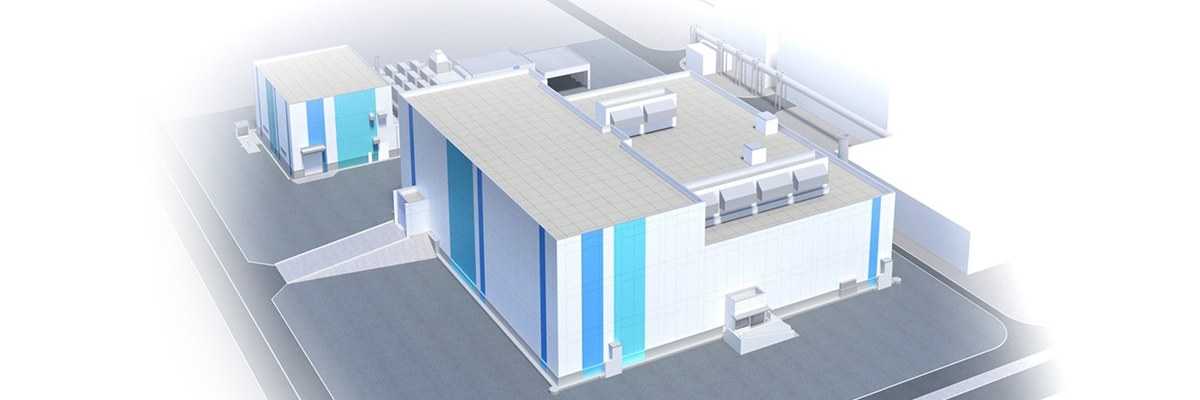
MOX Fuel
In nuclear power plants, plutonium is produced from uranium fuel during power generation, and some of it is also used for power generation after fission.
Uranium and plutonium, which can be reused as fuel, still remain in the spent fuel at nuclear power plants. The uranium and plutonium can be extracted by chemical processing of spent fuel (Reprocessing). MOX fuel is made by mixing the extracted uranium and plutonium.
"MOX" refers to mixed oxide fuel composed of uranium and plutonium.
Uranium fuel uses enriched uranium with 3-5% of uranium-235 by uranium enrichment, whereas MOX fuel uses plutonium instead of uranium-235.
Pluthermal
Using MOX fuels at a conventional nuclear power plant
Pluthermal refers to the use of MOX fuel composed of plutonium and uranium in conventional nuclear power plants (light water reactors = thermal reactors). This term is a combination of plutonium and thermal reactors.
All of the energy resources we currently use are limited. Uranium used in nuclear power plants is also limited. Japan, which relies on imports for most of its energy resources, needs to seriously consider the use of these resources.
In pluthermal, the uranium and plutonium recovered in reprocessing are recycled, thereby making effective use of energy.
About MOX Fuel Fabrication Plant (J-MOX)
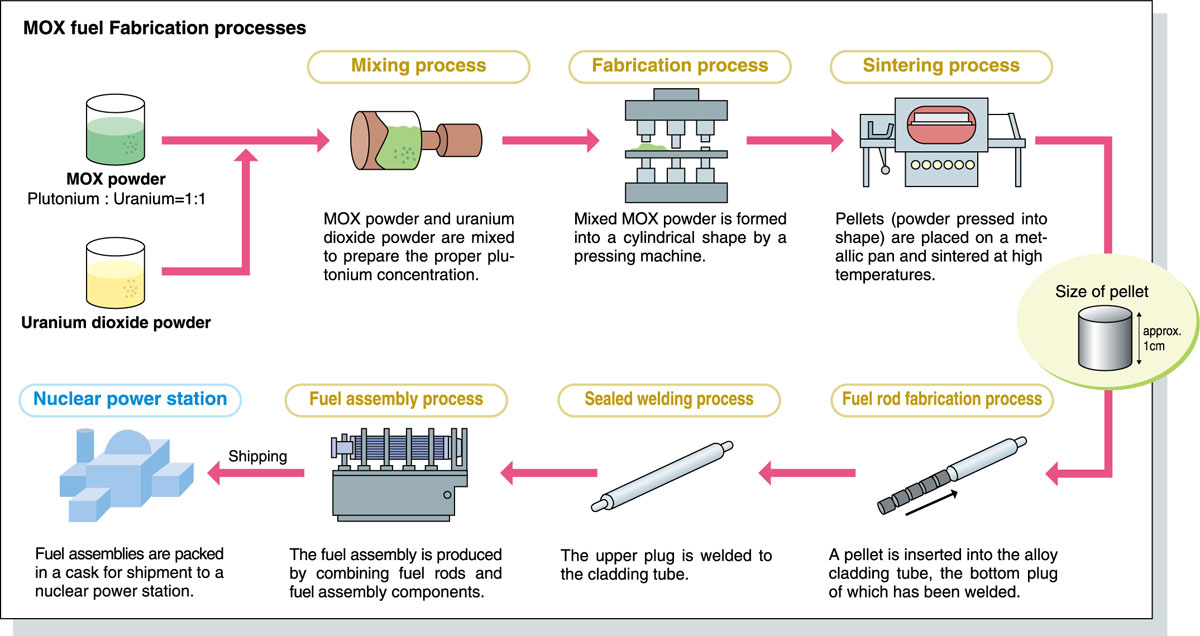
J-MOX processes MOX powder from the reprocessing plant into MOX fuel for use in nuclear power plants (light water reactors).
We are proceeding with construction work with safety as our top priority, with the aim of completing within the fiscal year 2027.
Plant overview
| Maximum processing capacity | 130t-HM/year |
|---|---|
| Product | MOX fuel assembly for domestic light water reactor (BWR and PWR) |
| Size | Approx. 85m × 85m, 2F-B3F |
| Layout plan of the plant | Adjacent to the reprocessing plant |
| Construction cost | Approx. 800 billion yen |
| Start of construction | October, 2010 |
| Completion | Fiscal year 2027 |
The MOX Fuel Fabrication Plant (J-MOX) is positioned as an important facility for plutonium recycling.
MOX fuel is manufactured from mixed oxide of uranium and plutonium produced by reprocessing. The capacity of the J-MOX is designed to match the amount of plutonium recovered through reprocessing at the RRP. In this way, all of the recovered plutonium will be surely consumed under the plutonium utilization program.
MOX fuel was first used in a thermal reactor in 1963. Since the 1980s, over 2,000 tons of MOX fuel has been fabricated and loaded into reactors (mostly PWR) for commercial use globally.
MOX fuel consists of about 7 to 9% plutonium mixed with reprocessed uranium, assuming that the plutonium has about two thirds fissile isotopes. Energy of MOX fuel is equivalent to 4% U-235 enriched uranium oxide fuel. The plutonium content of MOX fuel produced in J-MOX varies from around 4 to 9% depending on the design of the fuel.
The J-MOX will properly maintain necessary measures for Safety, Safeguards and Security.
Safety measures at the MOX Fuel Fabrication Plant (J-MOX)
J-MOX, where safety will be given top priority, rigorous criticality safety controls will be implemented. For instance, the dry process will be adopted for the production process from MOX powder to fuel assembly. Other major measures to assure safety are as follows:
- "Mass control" to keep nuclear fuel substances within the specified level
- "Placement control" to keep the canisters of MOX powders apart from each other.
- "Neutron absorber control" to absorb neutrons using boron, which prevents criticality.
These measures will be appropriately combined to realize the highest possible safety level. In addition, JNFL will introduce the same safety measures as those already implemented in our other businesses.